Introduction
Compensation benchmarking companies provide organizations with the market data and specialized tools needed to set competitive salaries, design equitable pay structures, and make informed compensation decisions. Whether you're an HR leader at a growing mid-market company or a compensation specialist at a global enterprise, selecting the right benchmarking partner directly impacts your ability to attract talent, maintain internal equity, and control unnecessary spending.
This guide covers the full spectrum of compensation benchmarking providers, from traditional survey firms like Mercer and Radford to modern software-first platforms like SalaryCube, plus hybrid solutions that combine both approaches. We focus on helping organizations of all sizes evaluate options based on data freshness, geographic coverage, industry specialization, and total cost of ownership. For hands-on tool comparisons, see our guides to salary benchmarking tools and compensation management software. For budget-conscious teams, our free salary data guide covers no-cost starting points.
The short answer: The 15 best compensation benchmarking companies for 2026 are: 1. SalaryCube, 2. Mercer, 3. Radford (Aon), 4. Payscale, 5. Willis Towers Watson, 6. Korn Ferry, 7. Culpepper, 8. Salary.com, 9. ERI, 10. Pave, 11. Ravio, 12. Comptryx, 13. Carta, 14. PeopleTech, and 15. Compensation Sciences. SalaryCube emerges as the overall winner for most companies due to its combination of daily-updated data, transparent methodology, and competitive pricing.
By reading this guide, you'll gain:
-
Clear understanding of different compensation benchmarking provider types and their methodologies
-
Practical evaluation criteria for comparing salary survey providers
-
Detailed comparisons of the top 15 benchmarking companies with pros, cons, and pricing
-
Selection guidance matched to your organizational needs
-
Implementation best practices and common challenge solutions
Understanding Compensation Benchmarking Companies
Compensation benchmarking companies are specialized organizations that collect, validate, and deliver salary data to help employers establish competitive pay ranges, build defensible salary structures, and support fair pay initiatives. In an era of increasing pay transparency legislation and intensifying talent competition, these providers have become essential partners in modern HR strategy.
These companies serve as the bridge between raw compensation data and actionable insights. They aggregate employee data from thousands of organizations, apply statistical validation, and present findings in formats that compensation specialists can use for everything from setting salary bands for new roles to justifying merit cycle management decisions to the board.
Core Functions and Services
Data collection methodologies vary significantly across providers. Traditional survey providers like Mercer and Radford rely on annual or semi-annual employer surveys where participating organizations submit detailed compensation survey data for defined job families and levels. Modern platforms like SalaryCube collect data continuously through HRIS integrations and employer-reported feeds, updating their compensation databases daily. Some providers also incorporate employee reported data from job seekers and public sources, though this approach requires more rigorous validation.
Validation processes ensure benchmarking data remains reliable. Quality providers apply statistical cleaning to remove outliers, establish minimum sample sizes for reporting, and maintain transparency about their methodology. For example, Radford McLagan's database includes data from over 8,700 participating organizations covering more than 30 million employees across 115+ countries. SalaryCube provides confidence scoring for role matches and displays sample sizes alongside all salary data, enabling users to assess data reliability before making pay decisions.
Delivery methods range from static reports to fully interactive platforms. Traditional firms typically deliver survey data as PDF reports or data files, often bundled with consulting services and strategic recommendations. Software-first platforms provide self-service dashboards with filtering capabilities, real-time benchmarking tools, and integration with existing hr systems. The best compensation management tool options combine both, giving users immediate access to data while providing consulting support for complex compensation strategy questions.
Market Data Evolution and Trends
The compensation benchmarking landscape is undergoing rapid transformation. The most significant shift is the transition from annual surveys to real-time data collection. While traditional salary surveys remain valuable for their depth and peer-group methodology, organizations increasingly need current market rate information to make competitive offers in fast-moving talent markets. SalaryCube's daily update frequency through their Bigfoot Live system exemplifies this trend, though traditional providers like Radford are responding by enhancing their platforms with AI-powered tools.
Integration with HR technology stacks has become essential. Modern benchmarking tools connect directly with HRIS platforms, enabling automated data contribution and seamless workflow integration. This reduces manual work for HR teams and ensures compensation data stays current. According to Mercer's Global Compensation Planning Report, organizations with integrated compensation analytics outperform those relying on standalone tools.
The focus on total rewards benchmarking continues to expand beyond base salary. With salary increase budgets projected to remain around 4.0% globally for 2026, organizations are increasingly competing through variable pay, equity compensation, and benefits data. This is particularly true for tech companies and life sciences firms where long term incentives often represent a significant portion of total compensation packages.
Types of Compensation Benchmarking Companies
Understanding the different categories of benchmarking providers helps organizations identify which approach best fits their specific needs, budget constraints, and operational requirements.
Traditional Salary Survey Providers
Traditional survey providers have dominated compensation benchmarking for decades. Companies like Mercer, Willis Towers Watson, and Radford conduct structured annual or quarterly surveys where participating organizations submit detailed pay data according to standardized job leveling frameworks.
Typical clients include large enterprises, multinational corporations, and organizations in regulated industries that require governance support and defensible methodologies for board reporting. These providers excel at global compensation surveys covering emerging markets and provide deep industry specific surveys for sectors like financial services and healthcare.
Strengths include unmatched global coverage, comprehensive salary surveys that span all job families, strong acceptance by compensation committees and auditors, and decades of benchmark history for trend analysis. Radford McLagan, for example, offers particularly strong coverage for tech and life sciences, making it the preferred choice for venture-backed startups approaching IPO.
Limitations center on data freshness: survey data is often 6-18 months old by publication. Costs run significantly higher than modern platforms, often requiring substantial participation fees plus data access subscriptions. The consultancy-led approach, while valuable for complex situations, can slow down day-to-day compensation decisions.
Modern Software-First Platforms
Software-first platforms represent the fastest-growing segment of the compensation benchmarking market. Providers like SalaryCube, Pave, and newer entrants prioritize real-time data collection, intuitive user experiences, and seamless workflow integration.
These platforms collect salary data through multiple sources: HRIS integrations that automatically pull anonymized compensation data from participating companies, direct employer submissions, and in some cases, job posting analysis. SalaryCube covers over 35,000 job titles with data updated daily, providing immediate access to current market trends rather than historical snapshots.
Built-in compensation management features differentiate these platforms from pure data providers. Most include salary range building tools, pay equity analysis capabilities, job matching with confidence scoring, and exportable reports for stakeholder presentations. SalaryCube's AI Job Match helps align internal roles with benchmark positions by turning any job description into a benchmark match in seconds.
Focus on user experience makes these tools accessible to HR leaders without deep compensation expertise. Rather than navigating complex survey reports, users can filter by geography, industry, headcount, and company stage to quickly find relevant benchmarking data for specific roles.
Hybrid and Specialized Providers
Hybrid providers combine traditional survey rigor with modern platform delivery. Some organizations merge third-party survey data with real-time feeds, allowing users to weight each source based on their specific needs. SalaryCube, for example, enables organizations to import existing survey datasets and overlay them with real-time market data for a blended view.
Specialized providers focus on specific industries, geographies, or compensation elements. Carta provides equity benchmarking for private companies, while Culpepper focuses on tech-specific surveys. Regional specialists offer deep coverage for markets underserved by global providers.
The line between categories continues to blur as traditional providers add software capabilities and modern platforms expand their data depth. Organizations should evaluate providers based on their specific requirements rather than categorical labels.
15 Best Compensation Benchmarking Companies
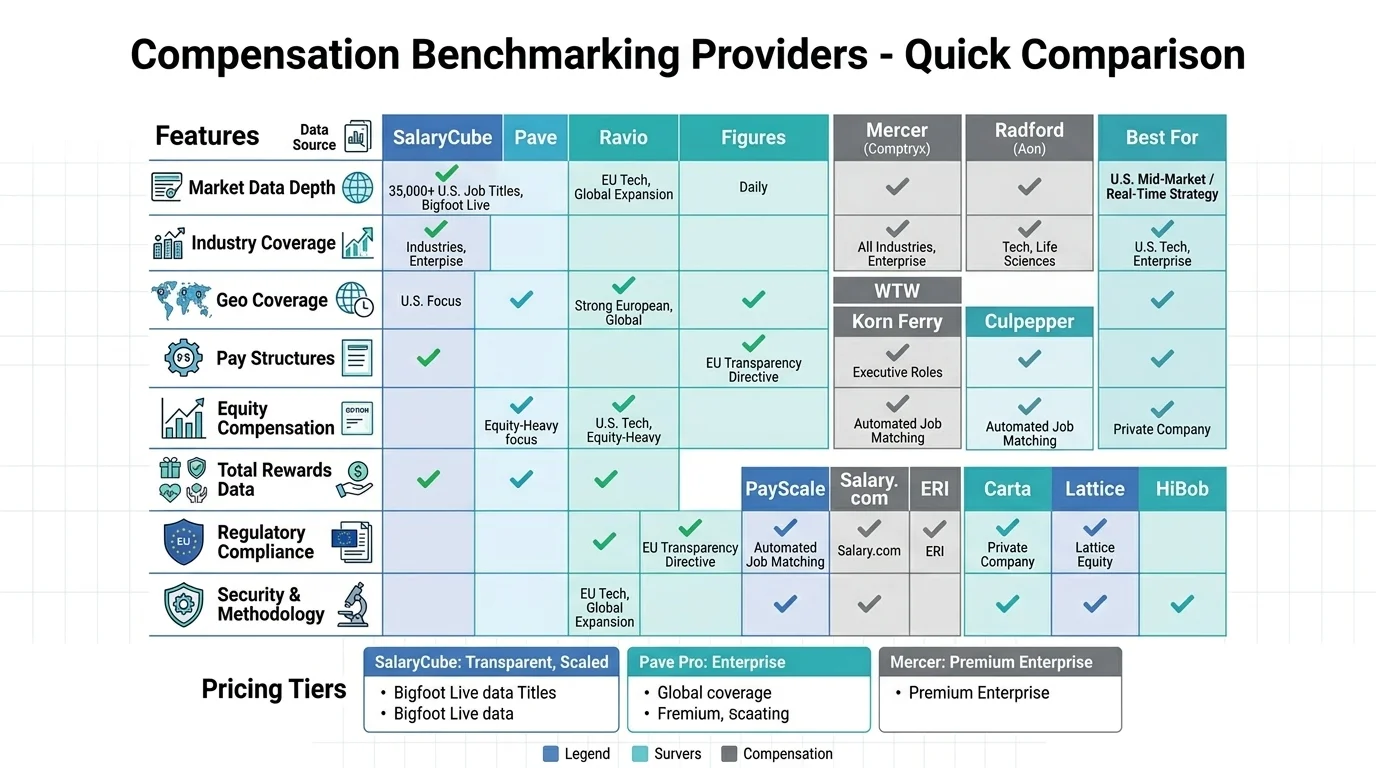
Selecting the right compensation benchmarking partner requires evaluating multiple factors: data freshness, geographic and industry coverage, job matching capabilities, total rewards depth, integration options, pricing transparency, and compliance features. The following analysis compares leading providers across these dimensions.
| Provider | Data Source | Update Frequency | Geographic Focus | Best For |
|---|---|---|---|---|
| SalaryCube | HRIS Integration + Employer Surveys | Daily (Real-time) | U.S. Primary, Growing Global | Mid-market to Enterprise seeking speed and value |
| Mercer | Annual Employer Surveys | Quarterly | Global (180+ countries) | Large enterprises with global workforce |
| Radford (Aon) | Industry Surveys + HRIS | Semi-annual/Rolling | Global with North America strength | Tech, Life Sciences, Financial Services |
| Payscale | Multi-source (Employer + Employee) | Monthly | U.S.-focused | SMBs to Mid-market |
| Willis Towers Watson | Employer Surveys | Quarterly | Global | Multinational corporations |
| Korn Ferry | Employer Surveys + Consulting | Quarterly | Global | Enterprises needing job architecture |
| Culpepper | Industry Surveys | Quarterly | U.S. + Select International | Tech-specific benchmarking |
| Salary.com | Multi-source | Monthly | U.S.-focused | SMBs and compliance needs |
| ERI | Published Sources + Surveys | Monthly | U.S. + Canada | Geographic differential analysis |
| Pave | HRIS Integration | Real-time | U.S.-focused | Venture-backed startups |
| Ravio | HRIS Integration | Real-time | Europe-focused | European tech companies |
| Comptryx | Employer Surveys | Semi-annual | U.S.-focused | Technology companies |
| Carta | Equity-specific | Real-time | U.S.-focused | Equity compensation for startups |
| PeopleTech | Employer Surveys | Quarterly | Australia/APAC | Regional APAC coverage |
| Compensation Sciences | Multi-source | Monthly | U.S.-focused | Healthcare and nonprofit |
When interpreting this comparison, note that "best for" designations reflect primary strengths rather than limitations. Most enterprise providers can serve organizations across sectors, but perform optimally in their areas of specialization. Organizations should request sample data for their specific roles and locations before committing.
1. SalaryCube: Best Overall for Real-Time Data and Value
SalaryCube has emerged as the leading compensation benchmarking tool for organizations prioritizing data freshness, transparency, and value. Their Bigfoot Live system provides daily-updated U.S. market data across 35,000+ job titles, with filters for geography, industry, headcount, and company stage enabling precise peer comparisons.
Pros:
- Real-time daily data updates eliminate the staleness problem plaguing traditional surveys
- Robust job matching with confidence scoring and hybrid role pricing for blended positions
- Unlimited exports and users included, with no per-report fees or seat-based pricing
- Comprehensive pay equity analysis tools with audit trails for compliance
- Implementation typically completes in under two weeks
- Methodology documentation supports pay transparency law compliance
Cons:
- Global coverage continues expanding but remains strongest in the U.S.
- Organizations with significant international headcount may need to complement with global survey data
Pricing: Transparent subscription pricing with unlimited reports and users. Typically delivers 30–50% lower total cost of ownership compared to traditional survey providers.
Ideal for: Mid-market companies through enterprises needing agile compensation decisions, organizations with distributed U.S. workforces, and teams seeking defensible market rate data without enterprise consulting costs.
2. Mercer: Best for Global Enterprises
Mercer's global reach and consulting depth make it the default choice for multinational corporations with complex compensation structures. Their Global Compensation Planning Survey covers 180+ countries with participation from thousands of organizations.
Pros:
- Unmatched global coverage including emerging markets across 180+ countries
- Strong governance support for board and compensation committee reporting
- Comprehensive total rewards statements benchmarking including benefits data
- Deep consulting services expertise for complex compensation strategy questions
- Decades of historical data for trend analysis
Cons:
- Higher cost structure than modern software-first platforms
- Quarterly update cycles may lag fast-moving talent markets
- Consultancy-led model adds time to routine compensation decisions
- Complex implementation process
Pricing: Premium pricing typically starting at $15,000–$50,000+ annually depending on surveys selected, geographic scope, and consulting hours. Participation fees may apply.
Ideal for: Large enterprises with significant international operations, organizations requiring heavy consulting support, and those needing data accepted by auditors and institutional investors.
3. Radford (Aon): Best for Tech and Life Sciences
Radford McLagan maintains its position as the premier choice for technology and life sciences companies. Their database covers 8,700+ participating organizations with over 30 million employees across 115+ countries.
Pros:
- Deep expertise in tech, life sciences, and financial services compensation practices
- Strong coverage of equity compensation and long term incentives critical for these sectors
- AI-powered Talent Intelligence Assistant enhances job matching and peer group selection
- Institutional-quality data accepted by boards, auditors, and investors
- Strong coverage for companies preparing for IPO
Cons:
- Semi-annual update cycles lag behind real-time platforms
- Pricing requires significant annual commitment
- Less comprehensive coverage outside core industry verticals
- Complex onboarding for first-time participants
Pricing: Enterprise pricing typically $10,000–$40,000+ annually depending on industry surveys and data cuts selected. Participation commitments required.
Ideal for: Tech companies at any stage, life sciences organizations, financial services firms, and companies preparing for IPO requiring institutional-quality data.
4. Payscale: Best for SMBs
Payscale offers a balanced approach combining employer-reported data with their extensive employee reported data pool. Their platform suits organizations seeking compensation software without enterprise pricing.
Pros:
- Broad role coverage across industries and company sizes
- Compensation planning tools with scenario modeling
- Pay equity analysis included in platform
- More affordable than full consulting firm alternatives
- Intuitive interface accessible to HR generalists
Cons:
- Employee-reported data requires careful validation and may skew results
- U.S.-centric coverage limits international applicability
- Enterprise features like advanced analytics require higher-tier plans
- Data freshness varies by role and market
Pricing: Tiered subscription model. Individual plans start free with limited access. Professional and enterprise tiers range from approximately $5,000–$25,000+ annually.
Ideal for: SMBs through mid market companies, organizations new to formal compensation benchmarking, and teams seeking integrated talent management features.
5. Willis Towers Watson: Best for Multinational Corporations
WTW combines traditional survey rigor with global reach across industries. Their approach suits multinational organizations requiring comprehensive salary structures across diverse geographies.
Pros:
- Extensive global compensation surveys spanning all major markets
- Strong benefits data benchmarking, among the best in the industry
- Established governance frameworks for executive compensation
- Deep experience with total rewards program design
- Comprehensive job leveling methodology
Cons:
- Traditional survey cadence limits real-time application
- Premium pricing comparable to Mercer
- Complex implementation and onboarding process
- Platform modernization lags behind software-first competitors
Pricing: Enterprise pricing typically $15,000–$50,000+ annually. Multiple survey purchases and consulting services priced separately.
Ideal for: Global corporations with diverse industry operations, organizations prioritizing benefits benchmarking, and companies requiring comprehensive total rewards analysis.
6. Korn Ferry: Best for Job Architecture
Korn Ferry excels at job architecture and provides integrated assessment and compensation solutions. Their Hay methodology remains an industry standard for job evaluation and leveling.
Pros:
- Industry-standard job evaluation methodology (Hay system)
- Integrated assessment and compensation solutions
- Strong job leveling frameworks for complex organizations
- Global coverage across industries
- Deep consulting expertise for organizational design
Cons:
- Methodology-heavy approach requires significant investment in job architecture setup
- Premium pricing reflects consulting-first model
- Data access tied to participation and consulting engagements
- Less agile for day-to-day market pricing decisions
Pricing: Enterprise consulting engagements typically $20,000–$75,000+ annually including job evaluation, survey access, and consulting hours.
Ideal for: Enterprises rebuilding their job families and leveling frameworks, organizations requiring formal job evaluation methodology, and companies undergoing organizational restructuring.
7. Culpepper: Best for Tech-Specific Benchmarking
Culpepper offers tech-focused surveys with strong coverage of software, hardware, and IT services roles. Their focused approach provides depth that generalist providers often lack for technology positions.
Pros:
- Deep coverage of technology roles including software engineering, product, and data
- Peer-specific data from tech company participants
- Quarterly survey cadence provides reasonably current data
- Strong coverage of variable pay and equity for tech roles
- More focused and affordable than large consulting firms
Cons:
- Limited coverage outside technology and related sectors
- Smaller participant base than major providers
- U.S.-focused with limited international coverage
- Less comprehensive platform compared to modern software tools
Pricing: Survey participation and data access typically $3,000–$15,000 annually depending on surveys selected.
Ideal for: Technology companies seeking peer-specific compensation data, IT departments within larger organizations, and tech startups that need industry-specific benchmarks.
8. Salary.com (CompAnalyst): Best for SMB Compliance
Salary.com's CompAnalyst platform combines multi-source data with built-in compliance tools. Their approach targets small to mid-sized organizations needing structured compensation management.
Pros:
- Broad role coverage across industries
- Built-in compliance tools for pay transparency requirements
- Compensation planning and salary structure building tools
- Job description management integrated with benchmarking
- Accessible pricing for smaller organizations
Cons:
- Data freshness varies; some sources rely on older survey cycles
- Advanced analytics require higher-tier subscriptions
- International coverage limited compared to global providers
- Platform can feel dated compared to modern competitors
Pricing: Tiered subscription pricing. CompAnalyst plans typically range from $3,000–$20,000+ annually depending on features and organization size.
Ideal for: SMBs needing structured compensation management, organizations focused on pay transparency compliance, and HR teams seeking combined job description and benchmarking tools.
9. ERI Economic Research Institute: Best for Geographic Differentials
ERI specializes in geographic differential analysis, helping organizations manage location-based pay data for distributed workforces. Their cost-of-living and salary assessor tools are widely used for relocation and remote work decisions.
Pros:
- Industry-leading geographic differential and cost-of-living data
- Strong coverage for location-based pay adjustments
- Useful for remote work compensation strategy
- Monthly updates provide reasonably current data
- Covers U.S. and Canadian markets comprehensively
Cons:
- Not a full compensation benchmarking platform; focused on geographic analysis
- Limited industry-specific survey data
- Less useful for job matching and total rewards benchmarking
- Interface is functional but not modern
Pricing: Subscription-based, typically $2,000–$10,000 annually depending on tools and data access selected.
Ideal for: Organizations managing distributed or remote workforces, companies establishing location-based pay differentials, and HR teams making relocation compensation decisions.
10. Pave: Best for Venture-Backed Startups
Pave targets venture-backed startups with real-time benchmarking and equity management. Their HRIS integration model provides current data from participating tech companies.
Pros:
- Real-time data through HRIS integrations from tech company participants
- Strong equity compensation benchmarking and management tools
- Purpose-built for startup and growth-stage compensation decisions
- Clean, modern interface with strong user experience
- Free tier available for early-stage companies
Cons:
- Participant base skewed heavily toward VC-backed tech companies
- Limited coverage outside technology sector
- U.S.-focused with minimal international data
- Less useful for mature enterprises or non-tech industries
Pricing: Free tier for basic benchmarking. Premium plans with advanced analytics and equity tools priced on company size, typically starting around $5,000+ annually.
Ideal for: Early-stage through growth-stage tech startups, companies managing equity compensation, and VC-backed organizations competing for tech talent.
11. Ravio: Best for European Tech Companies
Ravio provides European coverage for tech and digital companies, filling a gap left by U.S.-focused platforms. Their HRIS integration model delivers real-time data from European tech participants.
Pros:
- Strong European market coverage, particularly UK, Germany, France, and Nordics
- Real-time data through HRIS integrations
- Built for tech and digital companies with relevant peer data
- Modern platform with clean user experience
- Free benchmarking tier available
Cons:
- Limited U.S. coverage; not a fit for U.S.-focused organizations
- Participant base concentrated in European tech companies
- Smaller overall dataset compared to global providers
- Less depth in non-tech industries
Pricing: Free tier for basic benchmarks. Paid plans for advanced features and larger organizations, pricing varies by company size.
Ideal for: European tech and digital companies, organizations with significant European headcount, and startups hiring across European markets.
12. Comptryx: Best for Technology Company Surveys
Comptryx conducts employer surveys focused specifically on technology companies. Their survey data provides peer-group benchmarks for organizations competing in tech talent markets.
Pros:
- Focused tech company survey with strong participant base
- Covers all tech job families including engineering, product, and operations
- Semi-annual updates provide structured data collection
- Strong peer-group methodology for tech companies
- Covers base, bonus, and equity compensation
Cons:
- Semi-annual cadence means data can be 3–6 months old
- Limited to technology sector
- No self-service platform; data delivered as reports
- Smaller scale than Radford for tech surveys
Pricing: Survey participation and data access typically $5,000–$15,000 annually.
Ideal for: Mid-size to large technology companies seeking peer-specific survey data and organizations that prefer structured survey methodology over real-time platforms.
13. Carta Total Comp: Best for Equity Compensation
Carta provides equity benchmarking for private companies, leveraging their position as a leading cap table management platform. Their compensation data is unique in its depth of equity information.
Pros:
- Unmatched equity compensation data from cap table management platform
- Real-time equity benchmarks based on actual grant data
- Total compensation view combining cash and equity
- Natural integration for existing Carta cap table customers
- Strong for venture-backed and pre-IPO companies
Cons:
- Cash compensation data less comprehensive than dedicated benchmarking providers
- Participant base skewed toward VC-backed companies
- U.S.-focused with limited international coverage
- Less useful for public companies or organizations without equity programs
Pricing: Compensation benchmarking bundled with cap table management. Total Comp features available at premium tiers, pricing varies by company stage and cap table complexity.
Ideal for: Private companies with equity compensation programs, existing Carta cap table customers, and startups designing initial equity grant frameworks.
14. PeopleTech: Best for APAC Coverage
PeopleTech offers compensation benchmarking focused on Australia and the broader Asia-Pacific region. Their surveys provide depth in markets underserved by U.S. and European providers.
Pros:
- Strong Australia and APAC market coverage
- Industry-specific surveys for regional markets
- Covers base, variable pay, and benefits for APAC roles
- Local expertise and consulting support
- Quarterly updates maintain reasonable data freshness
Cons:
- Limited coverage outside APAC region
- Smaller participant base than global providers
- Less sophisticated platform compared to modern software tools
- Not a fit for organizations without APAC headcount
Pricing: Regional survey pricing, typically $5,000–$15,000 annually depending on surveys and markets selected.
Ideal for: Organizations with significant Australia or APAC headcount, companies expanding into Asia-Pacific markets, and regional HR teams needing local benchmarks.
15. Compensation Sciences: Best for Healthcare and Nonprofit
Compensation Sciences provides benchmarking focused on healthcare, nonprofit, and public sector organizations. Their specialized surveys cover sectors often underserved by major providers.
Pros:
- Deep healthcare and nonprofit sector coverage
- Specialized job matching for clinical, administrative, and mission-driven roles
- Monthly data updates provide reasonable freshness
- More affordable than enterprise providers for smaller organizations
- Strong understanding of sector-specific compensation structures
Cons:
- Limited coverage outside healthcare and nonprofit sectors
- Smaller participant base than generalist providers
- Less comprehensive platform and reporting tools
- Limited international coverage
Pricing: Survey access typically $2,000–$10,000 annually depending on organization size and surveys selected.
Ideal for: Healthcare systems and hospitals, nonprofit organizations, public sector entities, and mission-driven organizations seeking sector-specific benchmarks.
How to Choose the Right Compensation Benchmarking Company
Selecting the best compensation benchmarking company for your organization requires a structured evaluation across several key dimensions. Use this framework to compare providers against your specific needs.
1. Data Freshness and Update Frequency
How current is the data? For fast-moving markets and high-turnover roles, real-time or daily updates (SalaryCube, Pave) provide a significant advantage over quarterly (Mercer, WTW) or semi-annual (Radford) survey cycles. If your organization makes frequent compensation decisions (new hire offers, counteroffers, mid-cycle adjustments), prioritize providers with the shortest data lag.
2. Geographic and Industry Coverage
Match the provider to your workforce footprint. U.S.-focused organizations benefit from SalaryCube's depth across 35,000+ titles. Global enterprises need Mercer or WTW for international markets. Tech and life sciences companies should evaluate Radford's sector depth. European teams should consider Ravio for regional coverage.
3. Job Matching Quality
Evaluate how well the provider matches your internal roles to benchmark positions. Look for automated matching with confidence scoring, manual override options, and support for hybrid roles. SalaryCube's weighted hybrid role pricing and Radford's AI-powered matching represent current best practices.
4. Total Cost of Ownership
Compare all costs: subscription fees, per-report charges, seat licenses, survey participation fees, consulting hours, and implementation costs. Some providers appear affordable at the base price but inflate significantly with usage. SalaryCube's unlimited export and user model provides cost predictability that per-report pricing cannot match.
5. Integration and Implementation
Assess how the tool fits your existing HR technology stack. HRIS integration capabilities, implementation timelines, training requirements, and ongoing support models all affect total value. Modern platforms like SalaryCube typically deploy in under two weeks, while traditional providers may require months.
6. Compliance and Documentation
With pay transparency laws expanding rapidly, evaluate audit trail capabilities, methodology documentation, pay range generation tools, and pay equity analysis features. Your benchmarking provider should help you document and defend compensation decisions, not just inform them.
7. Reporting and Analytics
Consider how you'll consume and share the data. Unlimited exports, customizable dashboards, stakeholder presentation tools, and API access vary significantly across providers. Teams that need to democratize compensation data across managers benefit from platforms with flexible reporting.
8. Support Model
Traditional providers include consulting services but charge accordingly. Modern platforms emphasize self-service with customer success support. Match the support model to your team's compensation expertise: lean HR teams may benefit from consulting guidance, while experienced compensation teams often prefer self-service speed.
Implementing Compensation Benchmarking
Successfully implementing compensation benchmarking is a pivotal step for organizations aiming to build competitive, equitable, and data-driven compensation practices. The process goes beyond simply selecting a compensation benchmarking tool or salary survey provider; it requires a structured approach to integrating market data, compensation data, and survey data into your organization's compensation management framework.
A well-executed implementation ensures that compensation specialists and HR leaders can leverage comprehensive salary surveys, benefits data, and benchmarking tools to inform compensation decisions, design effective pay structures, and maintain internal equity. Whether your organization is in tech, life sciences, or any other sector, a thoughtful implementation process helps align compensation strategy with business objectives, supports talent management, and keeps your organization responsive to market trends and shifts.
The implementation journey typically involves assessing current compensation practices, mapping job families and salary ranges, integrating new compensation software or benchmarking tools, and establishing processes for ongoing review and adjustment. By focusing on both the technical and human aspects of change, organizations can maximize the value of their investment in compensation benchmarking and ensure a smooth transition to more strategic, market-aligned compensation management.
Change Management Strategies
Implementing compensation benchmarking often represents a significant shift in how organizations approach pay decisions, salary structures, and total rewards programs. To ensure a successful rollout and lasting adoption, it's essential to apply robust change management strategies that address both the technical and cultural aspects of this transformation.
1. Stakeholder Engagement: Begin by engaging key stakeholders (including HR leaders, compensation specialists, managers, and employees) early in the process. Clearly communicate the goals of compensation benchmarking, such as improving pay equity, enhancing internal equity, and aligning compensation packages with market data. Involving stakeholders in discussions about compensation survey data and market trends helps build buy-in and ensures that the new approach addresses real organizational needs.
2. Training and Support: Provide comprehensive training on new compensation management tools and compensation software. This includes hands-on sessions for using benchmarking tools, interpreting compensation data, and applying insights from salary surveys and benefits data. Ongoing support, such as help desks, user guides, and refresher workshops, ensures that compensation specialists and managers feel confident navigating new systems and making informed compensation decisions.
3. Phased Implementation: Adopt a phased approach to rolling out compensation benchmarking. Start with a pilot program in a specific department or job family to test the integration of market data and compensation survey data into existing pay structures. Use feedback from the pilot to refine processes before expanding organization-wide. This minimizes disruption and allows for adjustments based on real-world experience.
4. Monitoring and Evaluation: Establish clear metrics to monitor the effectiveness of compensation benchmarking. Regularly review how well new salary ranges, pay structures, and total rewards statements align with market trends and internal equity goals. Use compensation analytics to track outcomes such as offer acceptance rates, turnover, and pay equity improvements. Adjust your compensation strategy as needed to respond to market shifts and organizational priorities.
5. Communication: Maintain transparent and ongoing communication throughout the implementation process. Provide regular updates on progress, share success stories, and address concerns promptly. Clear communication helps demystify compensation benchmarking, reinforces its value, and encourages adoption across all levels of the organization.
By following these change management strategies, organizations can ensure that compensation benchmarking becomes an integral part of their compensation practices. This approach not only supports fair pay and compliance with evolving regulations but also empowers HR leaders to make data-driven decisions that attract and retain top talent.
Common Challenges and Solutions
Implementing and effectively using compensation benchmarking requires navigating several common obstacles. Understanding these challenges upfront helps organizations select appropriate providers and establish realistic expectations.
Data Quality and Validation Concerns
Challenge: Organizations struggle to assess whether benchmarking data accurately reflects their competitive market. Sample sizes for specialized roles may be insufficient, and validation methodologies vary significantly between providers.
Solution: Request transparency documentation from prospective providers detailing their data sources, validation processes, and sample size requirements. Evaluate sample reports for your key roles before purchasing. Prioritize providers like SalaryCube that display confidence levels and sample sizes alongside salary benchmarking results. Consider combining multiple sources for critical roles where single-provider data appears thin.
Job Matching and Role Alignment Issues
Challenge: Internal job titles and responsibilities rarely align perfectly with standardized benchmark positions. Hybrid roles combining multiple functions complicate matching further.
Solution: Choose providers offering robust job taxonomy and automated job matching capabilities with manual override options. SalaryCube's hybrid role pricing allows weighted combinations for blended positions. Invest time upfront in mapping your job architecture to provider job catalogs, and document your matching rationale for consistency and audit purposes.
Integration and Workflow Disruption
Challenge: Implementing a new compensation benchmarking tool can disrupt established processes, require significant training, and create data migration headaches.
Solution: Prioritize providers offering seamless HRIS integration with your existing hr systems. Evaluate implementation timelines: SalaryCube typically deploys in under two weeks while traditional providers may require months. Plan for change management and user training, particularly for compensation specialists who may have established workflows with previous tools.
Cost vs. Value Optimization
Challenge: Organizations struggle to justify benchmarking investments, especially when budget constraints limit options. Hidden costs for exports, consulting, or additional users inflate total cost of ownership.
Solution: Calculate ROI based on measurable outcomes: time saved per compensation decision, improved offer acceptance rates, reduced turnover from competitive positioning, and avoided penalties from pay equity compliance failures. Ensure pricing transparency by confirming all fees upfront. SalaryCube's unlimited export model eliminates surprise costs common with other providers.
Regulatory Compliance and Documentation
Challenge: Expanding pay transparency laws require organizations to document and defend their pay decisions with credible market data and clear methodology.
Solution: Select providers with built-in compliance features including audit trails, methodology documentation, and pay ranges that align with disclosure requirements. Ensure your chosen platform supports pay equity analysis breaking down compensation by protected groups to identify and address potential gaps proactively.
Conclusion and Next Steps
The right compensation benchmarking company depends on your organization's size, industry, geographic footprint, and data requirements. Traditional survey providers like Mercer and Radford deliver unmatched depth and global coverage for enterprises willing to invest in comprehensive solutions. Modern platforms prioritize speed, usability, and value for organizations needing agile compensation management.
SalaryCube emerges as the top choice for most organizations based on its combination of real-time data accuracy, transparent methodology, comprehensive features, and competitive pricing. For U.S.-focused companies across mid-market to enterprise scale, SalaryCube delivers the data freshness and workflow integration that traditional surveys cannot match, without sacrificing the rigor needed for defensible compensation practices.
Organizations with significant global operations should consider complementing SalaryCube's U.S. strength with global survey data from Mercer or WTW. Tech and life sciences companies may benefit from Radford's industry-specific depth, particularly for equity compensation benchmarking.
Immediate action steps:
-
Define your specific benchmarking requirements: geographic coverage, industry focus, update frequency needs, total rewards scope, and budget range
-
Shortlist 3-4 providers matching your requirements and request demonstrations
-
Request sample data reports for your most critical roles to evaluate data quality and relevance
-
Calculate total cost of ownership including implementation, training, and ongoing subscription
-
Plan implementation timeline and identify change management requirements
For deeper exploration, consider related topics including pay equity analysis methodologies, compensation philosophy development frameworks, and salary structure design best practices. Organizations investing in benchmarking typically benefit from parallel investments in compensation strategy documentation and manager training on pay decisions.
Additional Resources
Compensation Benchmarking Implementation Checklist
-
[ ] Document current compensation decision processes and pain points
-
[ ] Identify key stakeholders and secure budget approval
-
[ ] Define must-have features versus nice-to-have capabilities
-
[ ] Map existing job architecture and identify matching complexity
-
[ ] Evaluate HRIS integration requirements
-
[ ] Establish success metrics and review cadence
Sample RFP Questions for Evaluating Providers
-
What are your primary data sources and how do you validate accuracy?
-
What is your update frequency and methodology for maintaining data freshness?
-
How do you handle job matching for hybrid or non-standard roles?
-
What sample sizes and confidence levels can we expect for our target markets?
-
What compliance features support pay transparency and equity analysis?
-
What is your implementation timeline and support model?
ROI Calculation Framework
-
Time savings: Hours saved per compensation decision × compensation team hourly cost × annual decisions
-
Offer acceptance improvement: Increased acceptance rate × cost per failed search × annual offers
-
Turnover reduction: Reduced turnover rate × average cost per departure × workforce size
-
Compliance risk mitigation: Potential penalty avoidance + legal fee reduction + reputational value
Provider Trial Access
-
SalaryCube Demo: Request a personalized demonstration
-
Most providers offer limited trial access or sample reports; request these before committing to annual subscriptions
Frequently Asked Questions
Why do I need real-time compensation benchmarking data?
Pay markets shift faster than annual or quarterly survey cycles can capture. Real-time benchmarking data, like the daily updates SalaryCube delivers through its Bigfoot Live system, helps you spot market movements early, price roles accurately in competitive talent markets, and avoid basing offers on benchmarks that are 6–18 months stale. This matters most for fast-growing teams, high-turnover roles, and emerging positions where historical survey data lags behind what candidates are actually being paid.
How do compensation benchmarking companies validate their data?
Validation methods vary significantly by provider type. Traditional survey firms like Mercer and Radford apply statistical cleaning to employer-submitted data, remove outliers, and enforce minimum sample sizes, but rarely publish their methodology in detail. Modern software-first platforms like SalaryCube use automated validation checks, cross-source verification, and human review, then display confidence scores and sample sizes alongside every benchmark so users can assess reliability before making pay decisions.
What data sources do compensation benchmarking companies use?
It depends on the provider model. Traditional survey firms collect employer-reported pay data through structured annual or semi-annual participation surveys. Software-first platforms like SalaryCube source data through live HRIS integrations, direct employer submissions, and validated job posting data, refreshing benchmarks daily across 35,000+ job titles. Aggregator platforms combine datasets from multiple survey providers and real-time sources into a single interface. The freshness and methodology behind each source directly affects how actionable the data is for compensation decisions.
How often should compensation benchmarks be updated?
As often as your competitive landscape changes. For roles in high-demand markets (technology, healthcare, sales), real-time or monthly updates keep pay decisions aligned with what candidates actually expect. For stable roles in less competitive markets, quarterly updates may suffice. Annual refresh cycles consistently lag the market and increase the risk of misaligned offers, higher turnover, and pay equity gaps. SalaryCube's daily update cadence eliminates this risk for U.S.-focused organizations.
How much do compensation benchmarking companies typically cost?
Costs range widely by provider type. Traditional salary survey firms like Mercer and WTW typically run $10,000–$50,000+ per year depending on the number of surveys, geographies, and consulting hours included. Modern benchmarking platforms like SalaryCube offer transparent subscription pricing that typically delivers 30–50% lower total cost of ownership, with unlimited exports, unlimited users, and no per-report fees. HR platforms that bundle compensation data as add-ons to broader tools often charge incremental fees that inflate over time.
How do I evaluate which compensation benchmarking provider is right for my organization?
Start by defining your requirements: geographic coverage needs, industry focus, update frequency, total rewards scope, integration requirements, and budget. Then shortlist 3–4 providers and request sample data for your most critical roles. Compare data freshness, sample sizes, job matching accuracy, and total cost of ownership. SalaryCube offers personalized demonstrations where you can evaluate real benchmark data for your specific roles before committing.
What compliance features should I look for in a compensation benchmarking tool?
With pay transparency laws expanding across U.S. states and internationally, look for providers offering built-in audit trails, methodology documentation, defensible salary range outputs, and pay equity analysis capabilities. Your benchmarking tool should help you generate compliant pay ranges, document the market data behind compensation decisions, and analyze pay by protected groups to identify and address gaps proactively. SalaryCube includes all of these features with full export capability for compliance reporting.