Quick Answer
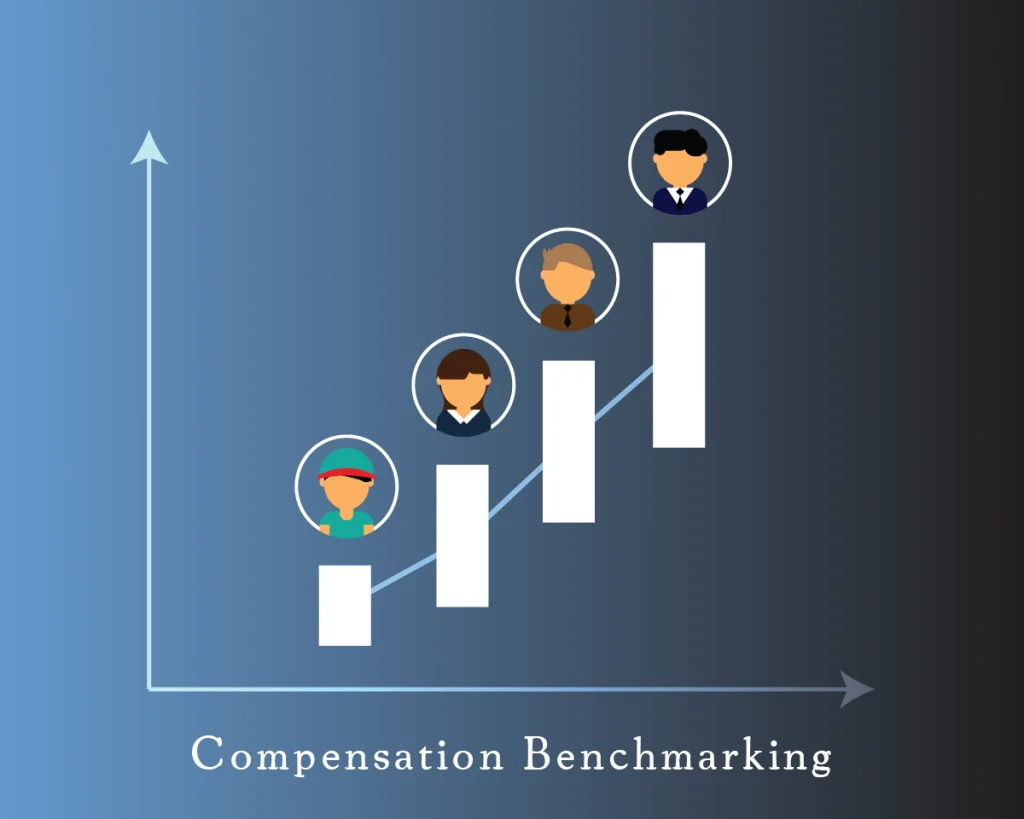
Compensation benchmarking is the systematic process of comparing your organization's job roles and pay levels against external market data to build defensible, competitive, and equitable pay structures. It involves job matching, data collection from surveys or real-time platforms, percentile analysis, and translating findings into salary ranges.
Who this is for
HR leaders, compensation analysts, and people operations professionals responsible for market pricing, pay range design, and compensation strategy at mid-market organizations.
Why it matters
Without structured benchmarking, organizations make pay decisions based on anecdote or outdated data, leading to pay compression, inequitable offers, compliance exposure under pay transparency laws, and preventable turnover.
Key fact
Traditional salary surveys typically cover 200–500 jobs and update annually, while real-time compensation intelligence platforms like SalaryCube's Bigfoot Live cover 35,000+ roles and update daily from over 800 million data points.
What Is Compensation Benchmarking?
Compensation benchmarking (also called salary benchmarking or market pricing) is the structured process HR and compensation teams use to compare their organization's pay practices against external market data for equivalent roles in comparable organizations. The goal is to establish pay levels that are competitive enough to attract and retain talent, equitable enough to withstand legal and internal scrutiny, and sustainable enough to fit within budget constraints.
This article is written for HR professionals, compensation analysts, and people operations leaders at U.S.-based organizations, particularly mid-market companies with 200 to 5,000 employees that need compensation intelligence without enterprise-suite complexity. If you are responsible for setting pay ranges, conducting pay equity analysis, managing merit cycles, or responding to pay transparency legislation, this guide covers the full benchmarking process from definition through implementation.
At its core, compensation benchmarking answers a deceptively simple question: Are we paying the right amount for each role, and can we prove it? The answer requires more than looking up an average salary. It demands a repeatable methodology that connects internal job content to external market data, translates percentile analysis into actionable pay ranges, and documents every decision for compliance and stakeholder review.
A well-executed benchmarking process produces three outputs that compensation teams depend on:
- Market-aligned pay ranges with defensible minimums, midpoints, and maximums for every benchmarked role
- A documented methodology that explains data sources, job matching rationale, and competitive positioning decisions, essential for pay transparency compliance and audit readiness
- Ongoing intelligence that keeps pay structures current as market conditions shift, rather than relying on a single annual snapshot
Organizations that skip formal benchmarking, or rely on ad-hoc Google searches and outdated survey PDFs, face predictable consequences: pay compression between new hires and tenured employees, inconsistent offers across hiring managers, difficulty pricing non-standard roles, and growing compliance risk as states like California, New York, Colorado, Illinois, and Washington expand pay transparency requirements.
Why Compensation Benchmarking Matters
Benchmarking is not a nice-to-have compliance exercise. It is the operational foundation that connects compensation philosophy to actual pay decisions. Here is why it matters across the functions HR and comp teams care about most.
Talent Attraction and Retention
Pay is not the only factor in retention, but it is the fastest way to lose people. When your ranges fall behind the market, top performers leave for organizations that benchmark regularly. Compensation benchmarking gives HR teams the data to make offers that are competitive on day one and stay competitive through the employee lifecycle.
Pay Equity and Legal Defensibility
Pay equity analysis is impossible without reliable external benchmarks. If you cannot demonstrate that your ranges are market-based and consistently applied, you cannot defend pay differences under EEOC scrutiny or state equal-pay statutes. Benchmarking creates the evidentiary foundation for fair-pay claims by anchoring every range to documented market data rather than subjective judgment.
Source note: The EEOC enforces Title VII and the Equal Pay Act, which require that pay differences be justified by legitimate, non-discriminatory factors. Market data from reputable benchmarking sources is widely accepted as a legitimate factor.
Pay Transparency Compliance
As of 2026, more than a dozen U.S. states and municipalities require salary ranges on job postings or upon request. These laws do not just require that ranges exist; they require that ranges be based on a good-faith determination of expected compensation. A documented benchmarking process is the most straightforward way to demonstrate that good faith.
Source note: Pay transparency laws vary by jurisdiction. California (SB 1162), New York (NYC Int. 134-A), Colorado (Equal Pay for Equal Work Act), Washington (SB 5761), and Illinois (HB 3129) each have distinct disclosure requirements. Consult legal counsel for jurisdiction-specific compliance.
Budget Discipline
Benchmarking prevents both overspending and underspending. Without market data, managers tend to either anchor offers to the last person they hired or escalate salary to close candidates quickly. A benchmarked range gives every hiring manager and department head a defensible corridor, reducing ad-hoc negotiations and making total compensation costs predictable across the organization.
Strategic Workforce Planning
Compensation benchmarking informs decisions well beyond base pay. It feeds into merit cycle budgeting, promotion calibration, geographic pay differentials, and total rewards design. Organizations that benchmark continuously, rather than once per year, can respond to market shifts in real time, adjusting ranges for hot roles or cooling markets before they create retention problems.
The Compensation Benchmarking Process: Step by Step
A defensible benchmarking process follows a predictable sequence. The stages below are designed for mid-market HR and compensation teams running the process in-house or with the support of a compensation intelligence platform.
Step 1: Define Scope, Philosophy, and Governance
Before collecting any data, establish what you are benchmarking, why, and who owns the process.
Key decisions at this stage:
- Which roles? Prioritize critical positions, high-turnover roles, roles affected by pay transparency laws, and any jobs with known pay equity concerns. Most mid-market organizations benchmark 60–80% of their workforce and use blended or hybrid pricing for the remainder.
- Compensation philosophy: Document your target market position. Common approaches include targeting the 50th percentile (market median) for most roles, the 75th percentile for hard-to-fill technical positions, or a lead strategy for executive roles. This philosophy anchors every subsequent analysis decision.
- Governance: Assign ownership. In a mid-market organization, the comp analyst or HR director typically owns the methodology, while the CFO or CHRO signs off on final ranges. Document approval workflows to ensure consistency.
- Cadence: Decide on a full benchmarking cycle (typically annual) plus interim market checks (quarterly or on-demand for critical roles). Organizations using real-time data platforms can shift to continuous benchmarking, refreshing data as needed rather than waiting for a fixed cycle.
Step 2: Build and Standardize Job Architecture
Accurate benchmarking depends on accurate job descriptions. If your internal titles are inconsistent ("Marketing Ninja" in one department, "Marketing Specialist II" in another), job matching will fail and your benchmark data will be unreliable.
What to standardize:
- Job families and levels: Group roles into families (Engineering, Finance, Marketing, Operations) and define clear career levels within each (Associate, Specialist, Senior, Lead, Manager, Director, VP).
- Job descriptions: Each benchmarked role needs a description that captures core responsibilities, minimum qualifications, scope of decision-making, reporting relationships, and FLSA classification. Benchmarking platforms match on job content, not titles, so the description is what matters.
- Title normalization: Replace ad-hoc titles with market-aligned naming conventions. This makes external matching faster and internal equity analysis possible.
A strong job classification framework is the backbone of consistent benchmarking. Without it, two people in identical roles can end up matched to different benchmark jobs, and paid at different rates, simply because their managers chose different titles.
Step 3: Select and Validate Data Sources
The quality of your benchmarking output is directly tied to the quality of your input data. Compensation data sources fall into four broad categories, each with distinct strengths and limitations.
Traditional salary surveys (Mercer, Radford/Aon, Korn Ferry/Hay, WTW) are employer-submitted, aggregated, and methodologically rigorous. They remain the standard for many enterprise organizations. However, traditional surveys typically cover 200–500 jobs, update annually, require months of participation, and can be expensive, making them difficult for mid-market teams to rely on exclusively.
Government labor databases (Bureau of Labor Statistics Occupational Employment and Wage Statistics, or BLS OEWS) provide free, large-sample data by occupation and geography. They are useful as a secondary validation source but tend to lag the market by 12–18 months and lack the granularity compensation teams need for individual role pricing.
Crowdsourced data (Glassdoor, Levels.fyi, Blind) offers directional signal, especially for technology roles, but suffers from self-selection bias, inconsistent job matching, and unverifiable submissions. Most compensation professionals treat crowdsourced data as a supplement, not a primary source.
Real-time compensation intelligence platforms represent the newest category. SalaryCube's Bigfoot Live, for example, covers 35,000+ roles with data updated daily from multilayered sources including job postings, public filings, and client participation, drawing on over 800 million data points across all U.S. industries and cities. Real-time platforms eliminate the annual survey wait, require no participation burden, and allow HR teams to refresh benchmarks on demand.
How to choose: Most mid-market organizations get the best results from a primary real-time dataset supplemented by one or two targeted traditional surveys for niche roles or specific industries. Document every source you use, why you chose it, and how you weight it when sources disagree. This documentation is critical for audit readiness and pay transparency compliance.
| Data Source Type | Update Frequency | Typical Job Coverage | Participation Required | Best For |
|---|---|---|---|---|
| Traditional surveys | Annual | 200–500 jobs | Yes (months) | Enterprise, niche industries |
| Government (BLS) | Annual (lagged) | ~800 occupations | No | Secondary validation |
| Crowdsourced | Continuous | Varies widely | No | Directional signal |
| Real-time platforms | Daily | 35,000+ roles | No | Primary benchmarking, speed |
Step 4: Match Internal Roles to Market Benchmarks
Job matching is the most nuanced step in the benchmarking process. A mismatch here (matching a senior individual contributor to a manager-level benchmark, or matching a hybrid role to a single-function job) cascades through every downstream analysis.
Matching principles:
- Match on content, not title. Compare responsibilities, scope, decision-making authority, and required qualifications. A "Director of Operations" at a 200-person company may match to a "Senior Manager" benchmark at a 5,000-person company.
- Document partial matches. When an internal role covers 70% of a benchmark job description, note the gap and adjust your analysis accordingly. Transparency here protects you in audits.
- Price hybrid roles deliberately. Many mid-market roles blend responsibilities across functions: a data analyst who also manages a team, or a marketing manager who owns the budget. For these roles, weight multiple benchmark jobs by percentage of responsibility rather than forcing a single match. SalaryCube's DataDive Pro supports this workflow with 17,000+ job titles organized by job family and level, plus the ability to filter by geography, industry, revenue, and headcount.
Step 5: Analyze Market Data and Set Competitive Position
With matched data in hand, the analysis stage translates raw percentiles into pay decisions.
Key analysis tasks:
- Percentile analysis: For each benchmarked role, examine the 25th, 50th, and 75th percentiles. Your compensation philosophy dictates where you target. To understand what these percentiles mean in practice, see the guide on what the 75th percentile means in salary data.
- Aging data forward: If your survey data is six months old, apply an aging factor to reflect expected wage growth. Real-time platforms handle this automatically, but traditional survey data almost always needs aging.
- Geographic adjustments: Apply location differentials where your pay philosophy requires them. A software engineer in San Francisco and one in Omaha may share a benchmark job but not a benchmark rate.
- Internal equity review: Before finalizing ranges, compare proposed rates to existing employee pay. Identify compression risks (new hires earning as much as tenured employees) and inversion risks (junior roles earning more than their supervisors). For a deeper treatment of compression dynamics, see the guide on pay compression.
- Outlier review: Flag any data points that seem disconnected from the rest of the market. Investigate before including or excluding them.
Step 6: Build Pay Structures and Ranges
Analysis produces insight; pay structures produce action. This is where benchmarking data becomes the salary ranges that govern every offer, promotion, and merit increase.
Building defensible ranges:
- Range spread: A typical range spread for professional roles is 40–60% from minimum to maximum (e.g., a range of $80,000–$120,000 for a role with a $100,000 midpoint). Broader ranges suit roles with longer tenure progression; narrower ranges suit roles with flatter career paths.
- Midpoint alignment: Set midpoints at your target percentile from the benchmarking data. The minimum and maximum flow from your range spread policy.
- Grade structures: Group roles with similar market values into grades or bands. This simplifies administration and creates clear promotion pathways. For a comprehensive treatment, see the pay structures guide.
- Configurable percentile recipes: Modern benchmarking platforms let you set P25/P50/P75 recipes and generate ranges automatically, eliminating manual spreadsheet work and reducing formula errors.
Step 7: Document, Communicate, and Maintain
A benchmarking process that lives only in one analyst's head is a liability. Documentation ensures continuity, auditability, and organizational trust.
What to document:
- Data sources and selection rationale
- Job matching methodology and any partial-match adjustments
- Compensation philosophy and target percentiles by job family
- Aging factors and geographic differentials applied
- Approval workflow and sign-off dates
- Refresh cadence and triggers for off-cycle review
Ongoing maintenance: Compensation benchmarking is not a one-and-done project. Market conditions shift, roles evolve, and new pay transparency laws take effect. The strongest programs refresh data quarterly for critical roles and conduct a full benchmarking cycle annually. Organizations using real-time platforms like Bigfoot Live can refresh benchmarks on demand, turning what was once an annual project into a continuous function.
Traditional Surveys vs. Real-Time Compensation Data
The choice between traditional salary surveys and real-time compensation intelligence is the single most consequential decision in your benchmarking process. It affects data freshness, coverage breadth, administrative burden, and how quickly you can respond to market shifts.
Traditional salary surveys have been the industry standard for decades. Providers like Mercer, Radford, WTW, and Korn Ferry collect employer-submitted data, validate it, and publish aggregated results. The methodology is rigorous and well-understood. However, the data is typically 6–18 months old by the time it reaches your desk, covers a limited number of jobs, requires significant participation effort, and often comes at premium cost.
Real-time compensation intelligence is a newer category that addresses these limitations. Platforms aggregate data from multiple layers (job postings, public filings, employer submissions, and proprietary sources) and update continuously. SalaryCube's Bigfoot Live, for example, updates daily and covers 35,000+ roles across all U.S. industries and cities, drawing on over 800 million data points. No survey participation is required, and data is available instantly.
The practical recommendation for mid-market teams: Use a real-time platform as your primary data source for broad coverage and speed, and supplement with one or two traditional surveys for industry-specific roles where your organization competes in a niche talent market. This blended approach gives you the freshness of real-time data and the methodological depth of traditional surveys, without the cost or burden of subscribing to a full survey library.
SalaryCube is purpose-built for this workflow. DataDive Pro supports survey import from Mercer, Radford, WTW, Comptryx, Payscale, and Salary.com, so HR teams can blend traditional survey data with real-time intelligence in a single platform rather than maintaining separate spreadsheets.
Common Compensation Benchmarking Pitfalls
Even experienced compensation teams make mistakes that undermine benchmarking quality. Here are the pitfalls that matter most, and how to avoid them.
Matching on Title Instead of Job Content
This is the most common and most damaging error. A "Vice President" at a 300-person company and a "Vice President" at a 30,000-person company are not the same role. Always match on responsibilities, scope, and qualifications. If your platform does not support content-based matching, you will need to do this work manually for every role.
Relying on a Single Data Source
No single source captures the full market. Traditional surveys undercount emerging roles; crowdsourced data overrepresents tech; government data lags. A blended approach, with documented weighting when sources conflict, produces the most defensible results.
Using Stale Data Without Aging
Survey data that is 12 months old reflects last year's market. If you do not age it forward, your ranges will lag from the moment you publish them. Apply an aging factor based on projected wage growth for your industry and geography, or use a platform that updates in real time.
Ignoring Internal Equity
External benchmarking tells you what the market pays. Internal equity analysis tells you whether your existing employees are paid fairly relative to each other and to the benchmarked ranges. Skipping the internal review creates compression, inversion, and morale problems that no amount of market data can fix.
Failing to Document Methodology
If your benchmarking rationale lives in someone's head or in an undocumented spreadsheet, it cannot survive an audit, a leadership transition, or a pay equity challenge. Document every decision (data sources, match rationale, philosophy, adjustments) and store it where it is accessible to the team.
Benchmarking Once and Forgetting
Markets move. A range set in January may be uncompetitive by July if a hot role takes off or a competitor raises pay across the board. Build a refresh cadence into your process (quarterly for critical roles, annually for the full portfolio) and use real-time data to flag when ranges need attention between cycles.
How to Choose a Benchmarking Approach
The right benchmarking approach depends on your organization's size, compensation maturity, and the resources available to your HR or comp team.
For organizations just starting out: Begin with a real-time compensation intelligence platform that provides broad job coverage and requires no survey participation. This gets you defensible ranges quickly without a large upfront investment in survey subscriptions or consultant fees. SalaryCube's free trial lets HR teams benchmark 5 roles and run 2 live market searches with no credit card and no data upload, and contributing anonymized compensation data through Open Benchmark returns matched benchmarking results at no cost, a practical starting point for organizations building their first formal process.
For teams with an established process: Evaluate whether your current survey stack gives you the freshness and coverage you need. If you are spending weeks each year participating in surveys and manually aging data in spreadsheets, a real-time platform can dramatically reduce that administrative burden while improving data currency. The ability to import existing survey data means you do not have to abandon your current investments.
For organizations under pay transparency pressure: Prioritize a benchmarking approach that produces documented, audit-ready output. You need to be able to show regulators, candidates, and employees that your ranges are based on current market data and a defensible methodology, not last year's survey or a manager's best guess.
For organizations pricing non-standard roles: Mid-market companies frequently have roles that do not map cleanly to traditional survey benchmarks: hybrid positions, roles unique to the business, or emerging titles. A platform with deep job coverage (17,000+ titles in DataDive Pro, 35,000+ in Bigfoot Live) and hybrid role pricing capabilities handles these situations without forcing you to guess or ignore the role entirely.
Connecting Benchmarking to Pay Structures and Pay Equity
Compensation benchmarking does not exist in isolation. It is the input that feeds two critical outputs: pay structures and pay equity analysis.
Pay Structures
Benchmarking data becomes actionable when it is translated into salary bands and pay structures. A pay structure groups roles into grades, assigns ranges to each grade, and defines the rules for movement within those ranges (merit increases, promotions, market adjustments). Without benchmarking, pay structures are arbitrary. With benchmarking, they are defensible.
The connection between benchmarking and pay structures should be explicit and documented. When you refresh your benchmark data, review whether your existing ranges still align with the market. When they do not, adjust ranges and communicate the rationale to managers and leadership.
Pay Equity
Pay equity analysis compares what employees in similar roles are paid relative to each other, controlling for legitimate factors like experience, performance, and geography. Benchmarking provides the external anchor (what the market pays for the role) while pay equity analysis examines whether internal pay differences are justified.
Organizations that benchmark without conducting pay equity analysis risk creating market-aligned ranges that still contain internal disparities. Organizations that conduct pay equity analysis without benchmarking risk flagging false positives, internal differences that are actually explained by market forces. Both analyses are necessary, and the strongest compensation programs run them in parallel.
What Compensation Benchmarking Is Not
To avoid common misconceptions, it is worth stating what benchmarking does not do:
- It is not salary negotiation advice for job seekers. This process is for the employer side: HR teams setting ranges and making pay decisions at scale.
- It is not a one-time project. Markets move continuously. A benchmark from 12 months ago is a historical artifact, not a current data point.
- It is not a substitute for compensation philosophy. Data tells you what the market pays. Philosophy tells you where you want to position relative to that market. You need both.
- It is not only about base pay. While base salary is the most commonly benchmarked element, total compensation, including bonuses, equity, benefits, and perks, should inform your competitive analysis.
Getting Started
Compensation benchmarking is the process that turns pay decisions from guesswork into strategy. Whether you are building your first formal process or modernizing an existing one, the fundamentals are the same: standardize your job architecture, choose reliable data sources, match on job content rather than titles, document every decision, and refresh your data on a cadence that matches the pace of your talent market.
For HR and compensation teams looking for a platform that combines real-time data, deep job coverage, and practical benchmarking workflows, explore the best salary benchmarking tools for 2026 to compare approaches, or start a free SalaryCube trial and contribute your own data through Open Benchmark to see matched benchmarking results at no cost.